CNC turning · Binh Duong, Vietnam
Bar and tube parts, turned to gauge — not just to print.
Bushings, caps, inserts, shafts and threaded fittings, cut on sliding-headstock equipment from bar and tube stock. We check thread fit with go/no-go gauges before a lot ships, not after a customer complains.
- Inches
- ±.0005
- Routine turned-feature tolerance
- Hours
- 48
- Quote returned from your drawing
- RMS
- 125
- Standard as-machined surface finish
- Grades
- 7
- Bar and tube materials running today
01 — What we actually run
Small, round, and made in volume.
Our turning work is bar and tube parts under roughly 40 mm in diameter, made thousands at a time. If a part needs heavy off-axis milling or pocketing, we route it to CNC milling instead of forcing it onto a lathe.
Typical parts
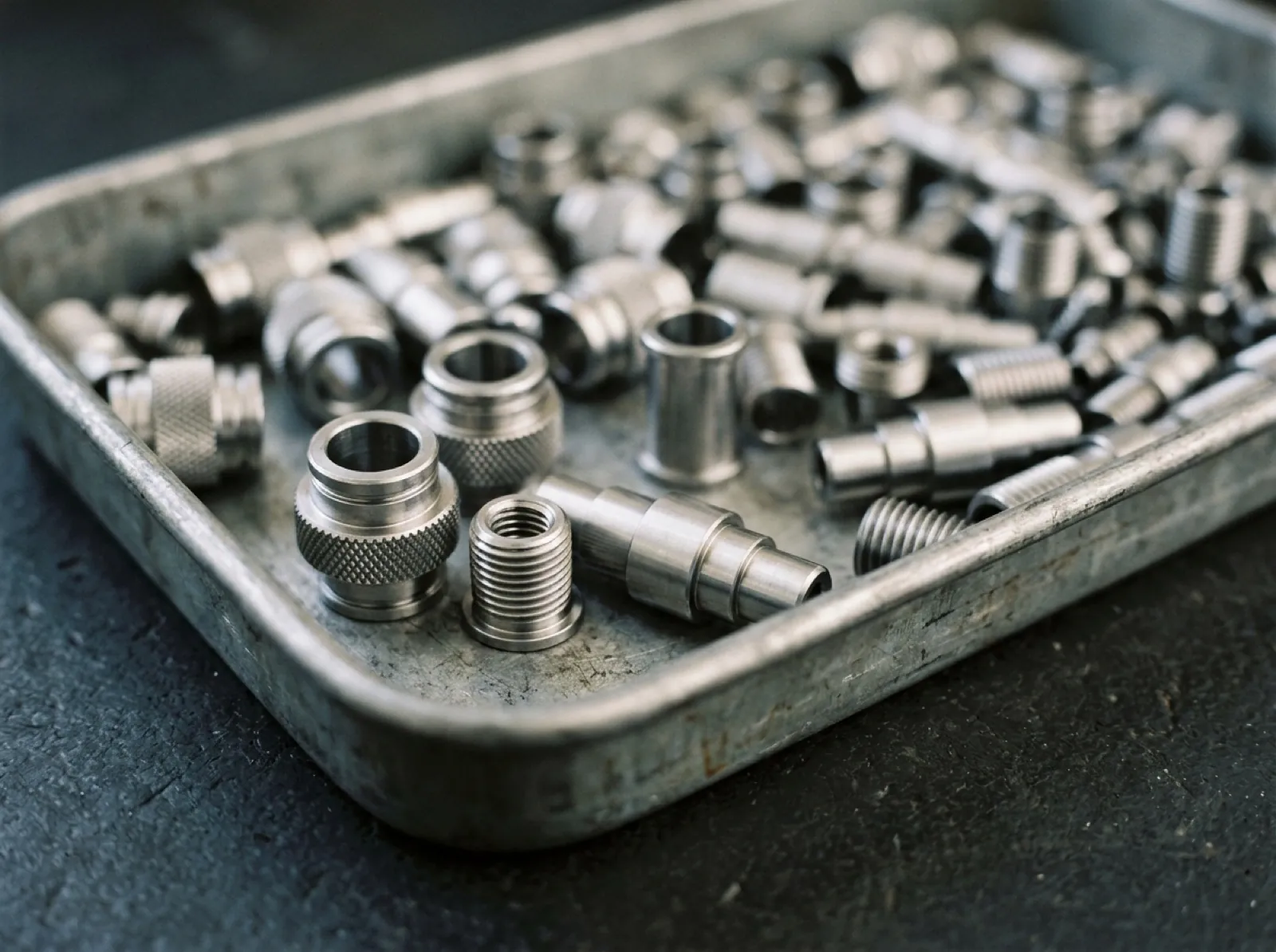
Bushings, spacers, caps, inserts, shafts, eccentric rings and threaded fittings. Most jobs come off sliding-headstock (Swiss-type) machines, which hold a part steady along its full length instead of cantilevering it off a chuck — the difference that keeps a long, thin shaft straight.
Features we cut routinely: straight and diamond knurling, ANPT and NPT threads gauged to ANSI/ASME B1.20.1, cross-drilled holes, grooves and chamfers.
02 — Process parameters
What we hold, and what we run it in.
One table, no adjectives. If a spec below is not enough for your drawing, tell us before tooling starts.
| Parameter | Specification |
|---|---|
| Turned-feature tolerance | ±0.0005 in. (0.013 mm), routine |
| Thread standard | ANPT and NPT to ANSI/ASME B1.20.1, gauge-checked |
| Surface finish, as-machined | 125 RMS |
| Secondary feature | Straight and diamond knurling |
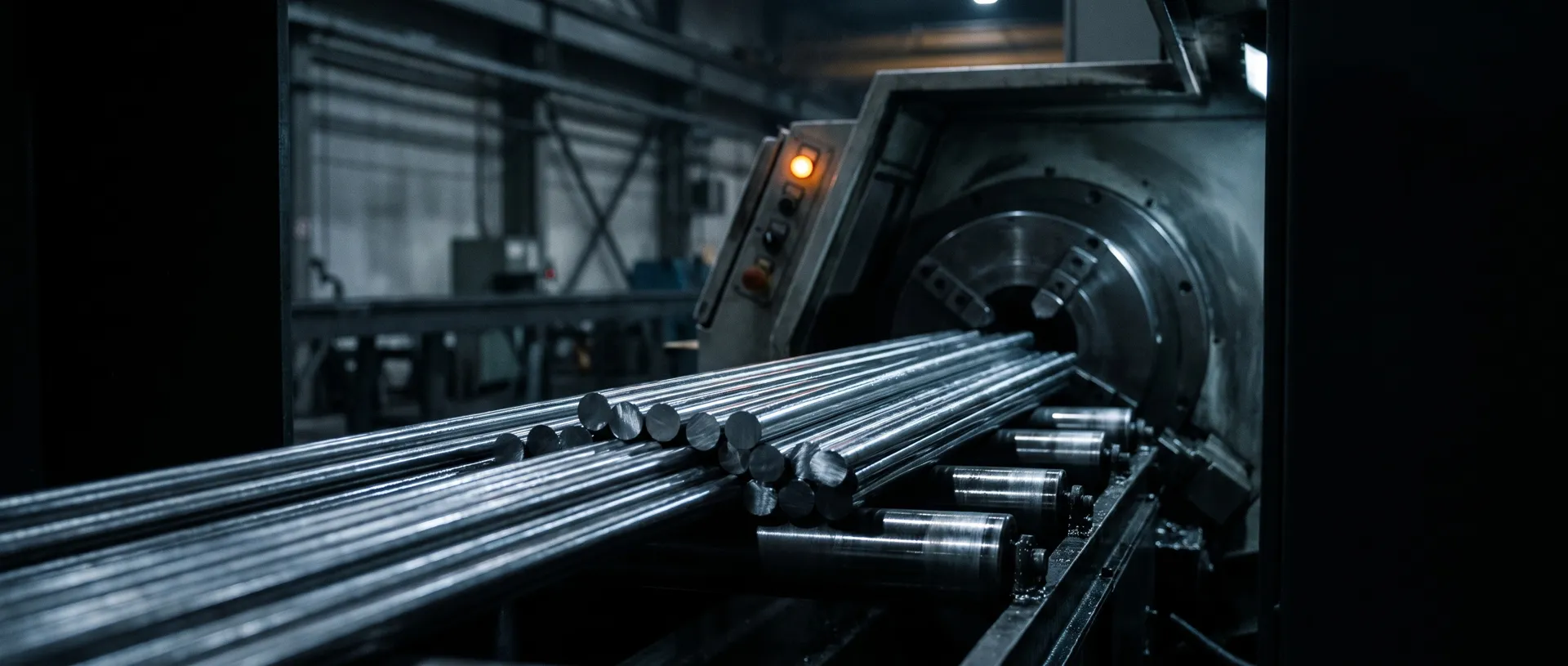
| Bar materials | Steel 52100, C1117, 12L14 · aluminum 2011-T3, 6061-T6 · silicon bronze |
| Tube material | ASTM A513 DOM steel tube, for sliding-headstock work |
| Finishes applied after turning | Electroplating, zinc plating, RoHS-compliant blue trivalent chromate, anodizing on aluminum, heat treatment, oil-dip rust protection |
03 — Take cost out of the drawing
Five changes that lower a turned-part quote.
None of these change what the part does. They change how long it sits in the machine and how much gets thrown away.
1. Specify a standard thread, not a custom pitch
ANPT or NPT to ANSI/ASME B1.20.1 uses gauges we already own. A custom thread form means a custom gauge set — an added cost that shows up in your unit price, not as a separate line.
2. Hold tight tolerance only where the part actually mates
±0.0005 in. (0.013 mm) is routine, but every dimension you call it out on adds inspection time. Leave non-functional diameters at commercial tolerance and we cut cycle time and scrap together.
3. Design within the guide-bushing envelope
Sliding-headstock turning is most efficient inside a standard bar diameter range. A part that needs a large-diameter flange on one end of a long, thin shaft forces a slower setup — split it into two parts if the assembly allows.
4. Standardize the knurl across a part family
Every knurl pitch change is a tool change. If your family has three similar parts, one shared knurl pitch keeps them running back to back instead of resetting the machine between them.
5. Pick bar stock over tube unless you need the bore
ASTM A513 DOM tube is the right call when the part is genuinely hollow through its length. If it only looks hollow on one end, a drilled bar is usually cheaper than qualifying a second raw-material stream.
04 — Where this is the wrong process
What turning does not do here.
Not for heavy prismatic features or five-axis work
A lathe cuts round features fast and cheap. It is the wrong tool for deep pockets, off-axis holes at odd compound angles, or anything that needs simultaneous five-axis motion — we do not offer that, on this process or any other.
Below roughly 2,000 pieces we are not competitive on a turned part; the setup and gauging time does not amortize. Say so on the drawing and we will tell you honestly instead of quoting a number that will not survive a second RFQ round.
05 — One supplier, one line
A turned part rarely ships bare.
Most turned bushings and shafts leave the lathe and go straight to finishing, or get paired with a cast body from the same order.
Surface finishing
Zinc plating, RoHS trivalent chromate or heat treatment applied to the same part number, same PO.
See the finish menuDie casting
A turned bushing or shaft pressed into a die-cast housing, delivered as one assembly.
See die castingCNC milling
When a turned part also needs an off-axis flat, hole or slot, it moves to a mill on the same floor.
See CNC milling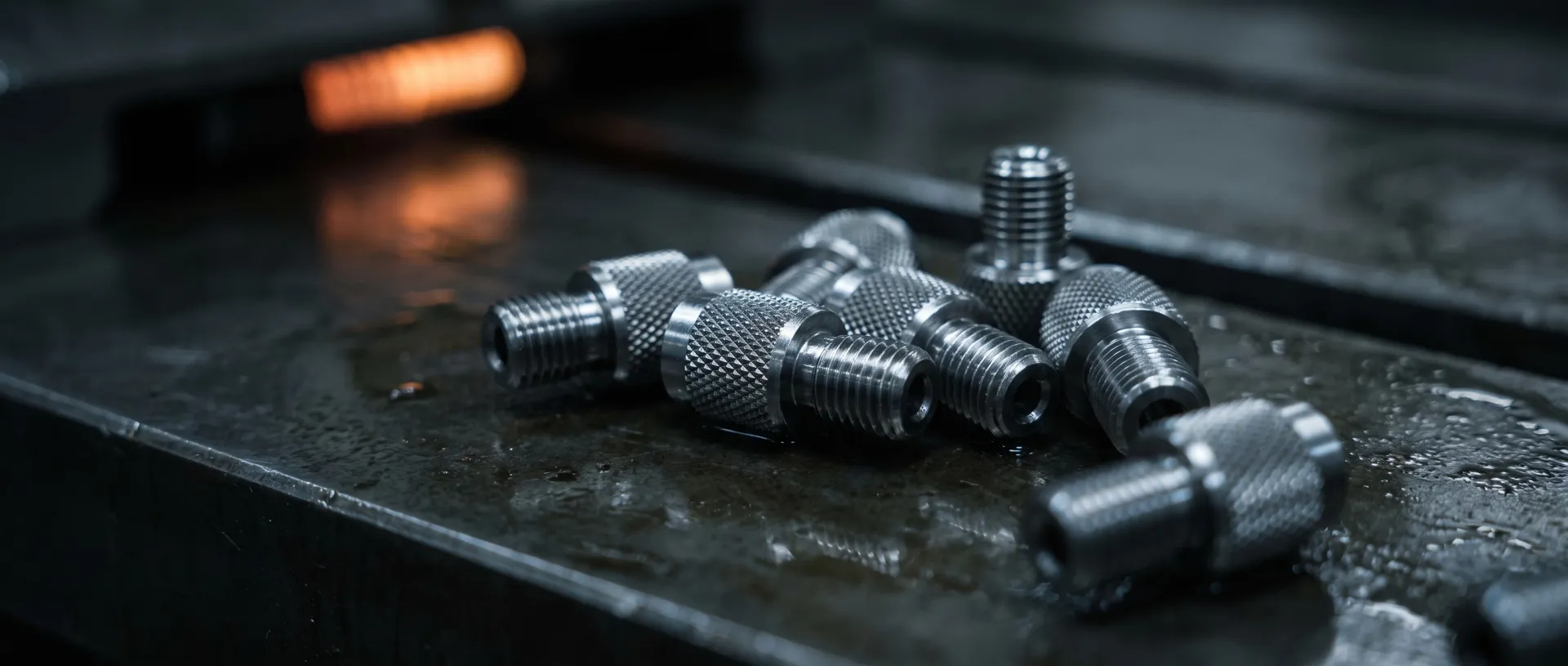
Do you do live tooling — milling on the lathe?
We run sliding-headstock turning with drilling and cross-holing, plus knurling and thread cutting. For deep pockets or off-axis milled features, the part moves to our CNC milling cell instead — same site, one PO.
What is your minimum order for a turned part?
Generally 5,000 to 30,000 pieces, depending on cycle time and material. Below roughly 2,000 pieces the setup and gauging cost does not amortize and we will tell you that up front.
Can you match a thread spec from an existing supplier?
If it is ANPT or NPT to ANSI/ASME B1.20.1, yes — we gauge to that standard as a matter of course. For a proprietary thread form, send the print and we will tell you honestly whether it is worth tooling for your volume.
Send a turned-part drawing. See what comes back.
STEP or PDF. You get a unit price at your volume, the lead time, and a short note on anything we would change to take cost out — within two business days.