
Guide
When does 4-axis CNC milling save a setup?
4-axis CNC milling is machining on a mill that adds one rotary axis, usually an A axis turning the part about the machine's X axis, to the three linear axes X, Y and Z. Short answer: it saves a setup when a part has features on several faces around one common axis, such as cross holes, flats or slots on a shaft or a housing, because the rotary axis turns the part to each face without unclamping it; it does not help with features on the ends along that axis or with true compound angles.
By Saola Manufacturing engineering team · Published · Updated
A fourth axis is one of the most common upgrades to a vertical machining center, and also one of the most misunderstood. Buyers sometimes ask for "4-axis" when what they need is fewer setups, and sometimes assume a fourth axis makes a part simple when its features are really on six sides. This guide explains what the rotary axis does, the difference between indexing and simultaneous 4-axis work, which part features benefit, how accurate the indexing is compared with refixturing, and how to write an RFQ that lets the supplier choose. Counting setups in general is covered in the design for machining guidelines.
On this page
What is the fourth axis on a CNC mill?
It is a rotary axis, mounted on the table or built into the machine, that turns the part about a line parallel to one of the linear axes. On most vertical mills it is an A axis, a rotary table or indexer lying on its side and turning the part about X.
The naming comes from the standard machine coordinate convention. The NIST RS274/NGC interpreter report (NISTIR 6556) defines X, Y and Z as a right-handed set of linear axes and labels the rotational axes A, B and C, with A parallel to X, B parallel to Y and C parallel to Z, measured in degrees. A horizontal machining center with a rotating table usually has a B axis instead; the principle is the same.
A fourth axis is often paired with a tailstock or a support spindle for long parts, and with a chuck, a vise or a dedicated fixture on the rotary faceplate. The rotary unit carries a clamp so that the part is locked once it has been turned to position.
What is the difference between 4-axis indexing and simultaneous 4-axis milling?
In indexing, the rotary axis turns the part to a fixed angle, clamps, and the machine cuts with its three linear axes; the axis only moves between cuts. In simultaneous 4-axis milling, the rotary axis turns while the tool cuts, which is needed for helical grooves, cams and wrapped profiles.
Most parts that benefit from a fourth axis need only indexing, sometimes called 3+1 machining. It covers flats at several angles on a shaft, holes on the faces of a hexagon or a square, radial hole patterns, and slots on opposite sides. Simultaneous 4-axis motion is the right tool for features that really wrap around the part: a helical groove, a barrel cam, an engraved band. The NIST report notes that rotational axes can move in coordinated motion with the linear axes, which is what simultaneous work uses.
The distinction matters for the RFQ. A supplier with an indexing rotary may quote your part happily; a part that needs simultaneous rotary contouring may need a different machine and a different program, so say so if a feature truly wraps.
Which part features does a fourth axis handle in one setup?
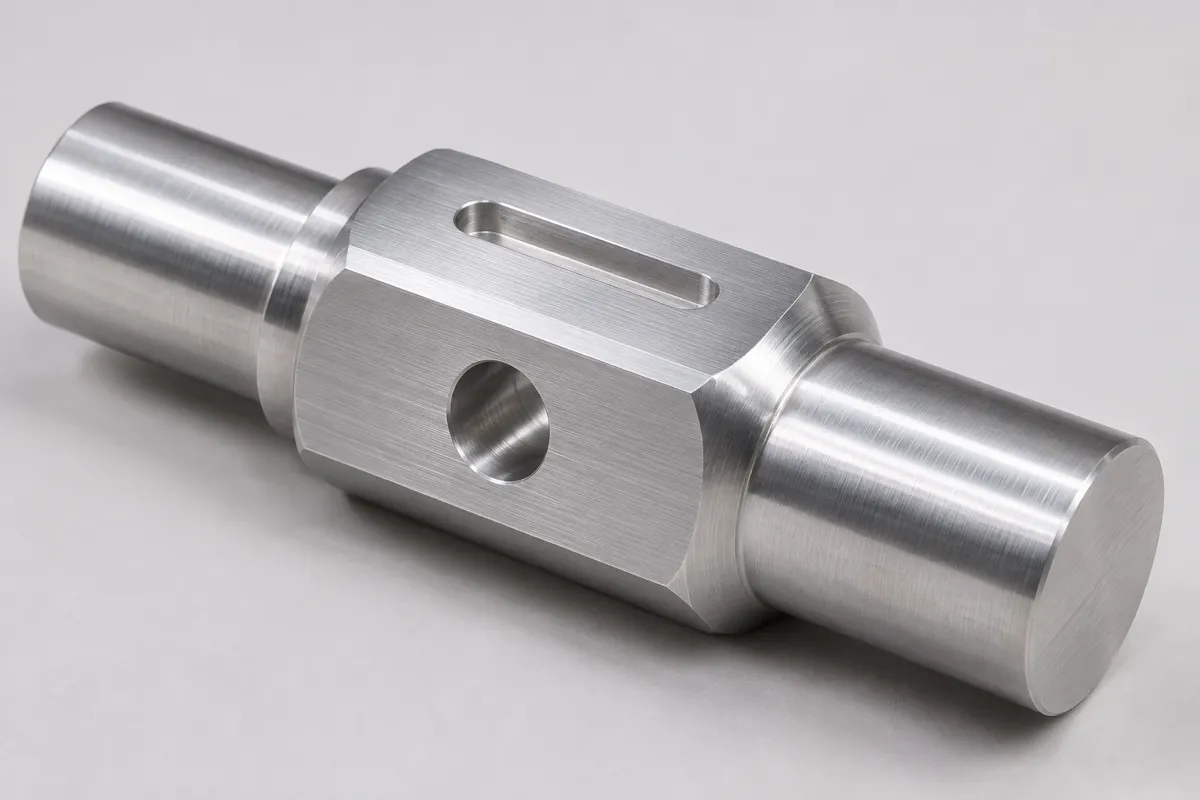
Features around the part's axis: cross holes at several angles, flats and slots on different sides, radial hole patterns, and features on the faces of square or hexagonal sections. Features on the two ends along the rotation axis, and on the face that is clamped, still need another setup.
The pattern is simple. A fourth axis wins when most features face outward around one axis of the part. It wins less when features are on many unrelated faces, and it loses when the part is flat.
Workholding sets the real limit. The face, bore or diameter that the chuck or fixture grips is not available to the tool, and the faceplate or tailstock blocks the ends. That is why many 4-axis parts are still two operations: one on the rotary for the side features, and one in a vise for the clamped end.
| Part and features | 3-axis vertical mill | With an indexing A axis | Notes |
|---|---|---|---|
| Shaft with flats and cross holes at 0°, 90° and 180° | One setup per face, usually three | Typically one | Part held in a chuck with tailstock support |
| Square or hex body with holes on four side faces | Up to four setups | Typically one, plus one for the ends | The clamped end still needs a second operation |
| Manifold block with ports on four sides | Up to four setups | Often one or two on a fixture | Fixture design decides access to the last face |
| Ring or flange with a radial hole pattern | Rotary indexer or several setups | One | Holes on the outside diameter, not the faces |
| Plate with features only on the top face | One setup | No benefit | A fourth axis adds cost, not value |
| Barrel cam or helical groove | Not practical | Needs simultaneous rotary motion | Indexing alone does not cut a wrapped path |
| Angle between features on different faces | Each refixture adds a new location error | Set by the rotary's indexing accuracy | Rotary axis accuracy is tested per ISO 230-2 |
Is 4-axis indexing more accurate than refixturing the part?
Usually, for the relationship between features on different faces, yes: a good clamped rotary table indexes to within about ten arc seconds, while each manual refixture adds a new location error from the datum faces, the fixture and the operator. The gain is largest when features on different faces are toleranced to each other.
Rotary table makers publish indexing accuracy in arc seconds. For example, the 2022 catalog of Koma Precision, a distributor of Tsudakoma rotary tables, lists an indexing accuracy of 10 arc seconds either way for its RWA-250R fourth-axis table. Machine tool builders test that kind of figure under ISO 230-2:2014, whose scope covers the accuracy and repeatability of positioning of numerically controlled axes and states that its methods apply equally to linear and rotary axes. The effect of that error on the part depends on how far a feature sits from the rotation axis.
Indexing error is rarely the largest error in the chain. The part must still be located on the rotary so that its axis lines up with the rotation axis, and any runout in the chuck or fixture moves every feature. A part gripped by a three-jaw chuck with poor runout can show larger errors than the table itself. Ask the supplier how the part is located on the rotary, not just whether the machine has one.
| Distance of feature from rotation axis | Error at 10 arc seconds | Error at 30 arc seconds | Error at 60 arc seconds |
|---|---|---|---|
| 10 mm | 0.0005 mm | 0.0015 mm | 0.003 mm |
| 25 mm | 0.0012 mm | 0.0036 mm | 0.007 mm |
| 50 mm | 0.0024 mm | 0.0073 mm | 0.015 mm |
| 100 mm | 0.0048 mm | 0.015 mm | 0.029 mm |
How should the RFQ describe a part that might need a fourth axis?
Describe the relationships the part needs, not the machine: put features that must line up with each other on the same datum reference frame, mark the critical ones, and give the annual volume. Then ask the supplier how many setups they plan and why.
A drawing that dimensions every cross hole from the same datum axis and the same angular datum tells any competent supplier which features belong together. If they plan to machine those features in one rotary setup, the relationship is protected; if they plan several setups, they know which relationships to check. Writing "4-axis required" on a drawing does not add that information, and it can rule out a supplier who would make the part well another way, such as with an angle head or a dedicated fixture.
Volume matters too. A fixture on a rotary table can hold several parts, so a fourth axis can pay off by cutting load and unload time per part as well as setups; the trade-off between setup cost and batch size is covered in the setup cost guide. For a handful of prototypes, a simple vise and two setups may be cheaper than building a rotary fixture.
Can Saola mill parts on a fourth axis?
The lead CNC plant runs 12 machining centers and 9 conventional CNC lathes; whether a given part runs on a rotary fourth axis or in indexed fixtures is confirmed at drawing review. Simultaneous five-axis machining is not offered.
The CNC milling page describes mostly second-operation milling on castings such as ADC12 aluminum, Zamak 3 and cast brass and bronze, where cross holes and ports on several sides of a housing are common setup questions. Shafts and round parts start on the CNC turning page. Send the drawing with the datum scheme and the features that must relate to each other, and the setup plan, including whether a rotary or a dedicated fixture is used, is part of the manufacturability note with the quote. The first-article inspection report covers the features marked on the drawing. Send drawings through the quote form.
Frequently asked
Is 4-axis milling the same as 3+1 machining?
3+1 usually means indexing: the rotary axis positions the part and clamps, then three linear axes cut. 4-axis can also mean simultaneous motion of all four axes, which is needed only for wrapped features.
Does a fourth axis replace a lathe for round parts?
Not for turned diameters. A lathe makes round surfaces; a rotary axis on a mill positions the part for milling and drilling. Many round parts are turned first and then milled on a fourth axis.
Can a fourth axis machine an angled hole that is not perpendicular to the rotation axis?
Only if the angle lies in the plane the rotary axis can reach. A hole tilted in two directions needs a second rotary axis or an angled fixture.
Does 4-axis milling cost more per part?
The machine hour can cost more, but fewer setups, fewer fixtures and less handling often offset it. The answer depends on the part and the volume, which is why the quote should show the setup plan.
What is a tombstone on a 4-axis machine?
A vertical fixture block mounted on a rotary axis, carrying several parts on its faces, so one cycle machines many parts and the rotary turns each face to the spindle.
Sources
- Kramer, Proctor, Messina, The NIST RS274/NGC Interpreter, Version 3 (NISTIR 6556), National Institute of Standards and Technology, 2000
- ISO 230-2:2014, Test code for machine tools, Part 2: Determination of accuracy and repeatability of positioning of numerically controlled axes (scope and status, confirmed 2025), via the Institute for Standardization of Montenegro, accessed November 2026
- Tsudakoma rotary tables catalog, RWA-250R specifications, Koma Precision, 2022