
Guide
When is gun drilling better than twist drilling for a deep hole?
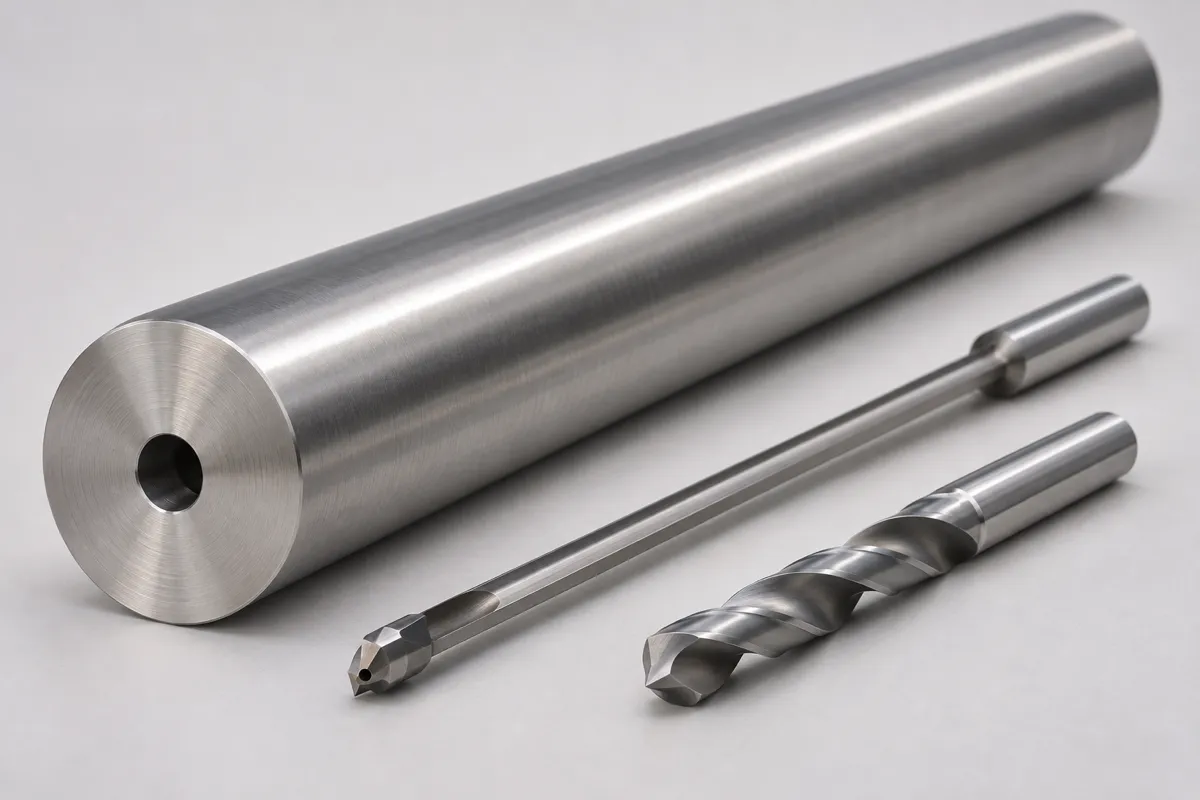
Gun drilling is a deep-hole process that uses a single-flute tool with an internal coolant channel and guide pads: coolant goes in through the tool, and chips are flushed back out along a V-shaped groove on its side. Short answer: switch from twist drilling to gun drilling when the hole is deep enough that a twist drill needs repeated pecking, wanders or leaves a poor bore, which equipment makers place at around twenty diameters deep and beyond, or earlier when the hole must be straight, round and finished in one pass.
By Saola Manufacturing engineering team · Published · Updated
For most machined parts, a twist drill is the right tool: it is cheap, fast and runs on any machine. Deep holes change the picture, because chips must travel a long way out of the hole and the drill has nothing to keep it on line except its own point. This guide explains where the two methods divide, what gun drilling needs from the machine and the part, how other options such as long carbide drills and BTA drilling fit in, and how to write a deep hole on a drawing. How straight a deep hole ends up, and how to measure it, is covered in the deep hole straightness guide.
On this page
How is a gun drill different from a twist drill?
A twist drill has two cutting edges and two helical flutes that carry chips out, and it centers on its own point. A gun drill has one cutting edge and guide pads that ride on the wall it has just cut, and it relies on high-pressure coolant through the tool to push chips out.
Those design differences explain the behavior. A twist drill's flutes pack with chips as the hole gets deeper, so the operator or program retracts it again and again (peck drilling) to clear them. Each peck costs time, and each re-entry is a chance for the drill to shift. A gun drill does not peck: according to UNISIG, a deep-hole machine builder, it produces a deep, accurate hole in a single pass, with coolant entering through the tool and chips leaving through the groove, and the guide pads burnish the bore as they go.
The guide pads also mean a gun drill cannot start a hole on its own. The tool maker botek states in its machining-center brochure that deep hole drilling tools are not self-centering and must be guided at the start by a sufficiently long pilot hole or a drill bushing.
At what depth-to-diameter ratio should you switch to gun drilling?
There is no single cut-off, but equipment makers present gun drilling as the process for holes about twenty diameters deep and beyond, and it is chosen earlier when straightness, roundness or finish matter. Below that, a long twist drill with coolant through the tool is often the cheaper choice.
The UNISIG article describes gun drilling as suitable when the depth-to-diameter ratio is 20:1 or greater, with accuracy maintained at ratios up to 400:1, for holes up to roughly 50 to 75 mm in diameter. The same article notes that twist drills typically needed multiple passes and produced less round, less straight holes, and that gun drilling is preferred when precise roundness or straightness is needed or when the workpiece is harder. In between, the decision rests on more than depth.
The table is about tendencies, not guarantees. A twist drill in free-machining steel with good coolant can drill deeper than one in sticky stainless, and a gun drill on a machining center with weak coolant can perform worse than a good carbide drill.
| Factor | Twist drill with peck cycle | Long coolant-through carbide drill | Gun drill | BTA (ejector or STS) |
|---|---|---|---|---|
| Typical depth range | Shallow holes; pecking as depth grows | Moderate depths on machining centers | From about 20:1 up to 400:1 (UNISIG) | Same extreme ratios, larger diameters |
| Diameter range | Wide | Wide | Up to roughly 50 to 75 mm (UNISIG) | Above the gun drill range |
| Starts its own hole | Yes | Long tools may need a pilot | No; needs a pilot hole or bushing | No; needs a bushing |
| Pilot hole | Not needed | Depends on tool length | ISO tolerance G6 recommended for precise holes (botek) | Bushing instead |
| Chip evacuation | Flutes, cleared by pecking | Flutes plus coolant | Coolant in through the tool, chips out along the V groove | Coolant outside, chips through the drill tube |
| Hole quality | Least straight and round of these | Better | Straight, round, burnished | Straight, round |
| Machine needs | Any machine | Through-spindle coolant | High coolant pressure and flow, fine filtration, guarding | Dedicated deep hole machine |
What does gun drilling need from the machine and the part?
It needs coolant at high pressure and flow through the tool, good filtration, a pilot hole or bushing for entry, and a way to support a long, slender tool. A part design that gives the drill a flat, square entry face helps as much as any machine feature.
Coolant does the chip removal, so pressure and flow decide whether gun drilling works at all. UNISIG's article warns that retrofitting gun drilling to an existing machine is effective only up to a 10:1 ratio, generally in common materials, and that a dedicated deep-hole machine is better for extreme ratios and harder materials. The botek brochure says the same kind of tools can run on machining centers, horizontally or vertically, with a rotating tool or a rotating workpiece, provided the machine is equipped for deep hole drilling and guarded against coolant and chips.
The start-up routine matters too. botek tells users to feed the gun drill into the pilot hole while it is not rotating or turning slowly, then start the coolant and spindle, and to stop the coolant and retract slowly at the end; it also warns against running long tools unsupported. For the drawing, that means a flat entry face square to the hole axis, no cross holes or slots at the entry, and enough material at the exit for breakthrough without a burr wrapping into a seal face.
When is a deep hole better made another way?
Consider drilling from both ends, boring from a smaller drilled hole, a tube or a two-piece design when the hole is deep but its straightness and finish are not critical, or when the volume is too small to justify gun drill tooling. The best deep hole is sometimes the one you do not have to drill.
Drilling from both ends halves the depth of each hole, at the cost of a step or a small mismatch in the middle; that is often acceptable on coolant or lubrication passages. A tube or bar with a drawn bore, such as DOM steel tube, gives a long bore without drilling at all, and the bore can then be finished where it matters. A cross-drilled passage that only carries fluid can often be relocated so that it does not need to be deep. The design for machining guidelines cover the general case of making features easier to machine.
How should a deep hole be called out on the drawing and RFQ?
Give the diameter tolerance, the depth, the straightness or exit position you need, and the bore finish if it seals or slides; leave the method to the supplier unless you have a reason to name gun drilling. Mark cross holes and the entry and exit faces clearly.
A drawing that specifies what the hole must do, not how it is made, lets the supplier pick twist drilling, gun drilling or boring and price accordingly. If you need a straight hole, state a straightness or position at the exit; if the bore seals an O-ring or a piston, give a surface texture requirement. Writing "gun drill" alone on the drawing does not say how straight or how smooth the hole must be, and it can force a costlier process where a cheaper one would meet the function.
In the RFQ, include the material and its condition, the annual volume, and whether a mid-length mismatch is acceptable if the hole is drilled from both ends. Those three answers often decide the process before anyone looks at the depth ratio.
Can Saola supply parts with deep or gun-drilled holes?
The lead CNC plant runs CNC turning and CNC milling, and whether a given deep hole is twist drilled, drilled from both ends or gun drilled is confirmed at drawing review. Send the depth, diameter and straightness requirements with the drawing.
The CNC turning page describes small-diameter bar and tube parts on conventional CNC lathes, including DOM steel tube, which is one way to avoid drilling a long bore. The CNC milling page covers second-operation machining on castings, where long cross holes and passages are common. For any hole deep enough to raise the question, state the function and the tolerances, and the process route is agreed at drawing review before the order. Send drawings through the quote form.
Frequently asked
Can a gun drill run on an ordinary CNC lathe or machining center?
It can if the machine has enough coolant pressure, flow and filtration, a pilot hole or bushing for entry, and suitable guarding. Equipment makers note that a retrofit works best at moderate depths and in common materials.
Why does a gun drill need a pilot hole?
It has a single cutting edge and guide pads instead of a self-centering point, so it must be guided into the work until the pads are supported by the hole it is cutting.
Is a gun-drilled hole finished, or does it need reaming?
The guide pads burnish the wall, which can remove the need for some finishing steps. Whether it meets a tight size or texture requirement without reaming or honing depends on the material and the tolerance.
What is the difference between gun drilling and BTA drilling?
Gun drilling feeds coolant through the tool and flushes chips outside it. BTA feeds coolant around the outside and removes chips through the drill tube, which suits larger diameters.
Does gun drilling work in stainless steel and aluminum?
Yes, with geometry and coolant suited to the material. Gummy stainless and soft aluminum both make chip control the deciding factor, so ask the supplier how they will evacuate chips.
Sources
- Anthony Fettig, Gunning for Better Results, UNISIG, originally published January 2012, accessed November 2026
- Deep hole drilling tools on machining centers, brochure 250 000 004, botek Präzisionsbohrtechnik GmbH, 2023