Guide
Trading company vs manufacturer: who should make your custom metal parts?
A trading company is a seller that takes your order for custom metal parts and places the work with factories it does not own. A manufacturer is the company whose plant actually casts, machines and finishes the part. The difference matters most when you need to know which plant made a part, where its metal came from and what work was done where.
By Saola Manufacturing engineering team · Published · Updated
This page is for a US or European buyer who sources machined or cast parts through a trading company or sourcing agent in Asia, and whose origin file or supplier audit keeps getting a vague answer to one question: which plant made the part, from what metal? It covers what changes when you buy from the plant, what stays the same under US customs law, and what Saola Manufacturing, a managed manufacturing partner whose CNC work runs at a lead plant in Vietnam, puts in writing, including where Saola is itself the middleman.
Nothing here claims that trading companies hide things or cut corners; many are excellent. The point is structural: when the seller is not the maker, what you learn about the plant reaches you second hand.
On this page
What changes when the seller is not the maker?
Your view of the plant, the routing and the material source goes through the intermediary, so you see only what the intermediary knows and chooses to pass on. The contract, the invoice and the engineering conversation all sit one step away from the machines.
That structure is not good or bad in itself. It becomes a problem in three situations that metal-parts buyers meet often:
- A drawing question. A tolerance, a datum or a thread callout needs a decision. The question travels from your engineer to the intermediary, to the factory, and back. Each hop is a chance for the detail that mattered to drop out.
- A quality escape. When a lot fails, you need the routing, the inspection record and the person who can change the process. If the factory is not named, you cannot go and look.
- An origin or audit file. Customs and supplier-quality teams ask for facts about manufacture: who made it, from what, and where each operation happened. An invoice from a trading company answers none of those on its own.
A good intermediary can close all three gaps by naming the factory and passing on its documents. Ask any seller whether it will.
Does buying through a trading company change the country of origin?
No. Under US regulations, the country of origin is where the article was manufactured, and later work elsewhere changes it only if that work is a substantial transformation, so the company that sends the invoice does not enter the test at all.
The rule is in the definitions section of the country-of-origin marking regulations (19 CFR 134.1(b)). It looks at the country of manufacture, production or growth, and at whether further work in another country produced a substantial transformation. Nothing in it turns on who sold the goods or where the seller is registered. A part cast and machined in one country and invoiced by a company in another still takes its origin from the plant.
That is why the plant's identity is not a detail. If you cannot say where the part was made and what was done there, you cannot apply the test. The responsibility to get it right sits with the importer: US law requires the importer of record to use reasonable care when it files the entry and declares value, classification and duty rate (19 USC 1484(a)). Buying through an intermediary does not move that duty to the intermediary, and buying from a plant does not move it to the plant either.
The same fact gap shows up when you ask US Customs for an advance answer. A binding ruling may be requested by a person with a direct and demonstrable interest, such as an importer, or by its authorized agent (19 CFR 177.1(c)). The request has to give a complete statement of the relevant facts, including the names and addresses of all interested parties where known (19 CFR 177.2(b)(1)). A request that cannot describe the manufacturing process is a weak request. The Vietnam transshipment guide covers what happens when an origin claim fails.
What can a buyer get from the plant that makes the part?
From the plant itself you can get the legal entity's registration, a per-part origin file and a written routing, and you can see the floor. At Saola those items are published as standing offers, not favors.
Saola Manufacturing is a brand of Aximora Global Trading Co., Ltd., registered in Ho Chi Minh City in 2026. Our CNC work runs at our lead partner plant, T.K Viet Nam Precision Company Limited, registered in 2017 in the former Binh Duong Province. Both business registration certificates are sent on request, so you know exactly who you would be contracting with and who makes the part. The quality page lists every document the plant issues and when.
For customs work, the tariffs and origin page commits to a file per part number with these contents:
- Purchase invoices, supplier and country of origin for the steel, aluminum ingot or brass bar the part is made from.
- A written English process routing: the operations from blank to finished part, and the value added in Vietnam, attached to the quote.
- A Certificate of Origin on Form B, issued through Vietnam's Ministry of Industry and Trade.
Form B changed hands recently. Under Decision 1103/QD-BCT, signed on April 21, 2025, the Ministry withdrew the authority it had delegated to the Vietnam Chamber of Commerce and Industry to issue it, and the Chamber stopped issuing Form B from May 5, 2025 (Ministry of Industry and Trade). A certificate is still only a certificate. CBP looks at the manufacturing process behind it, which is why the routing and the material file matter more than the form.
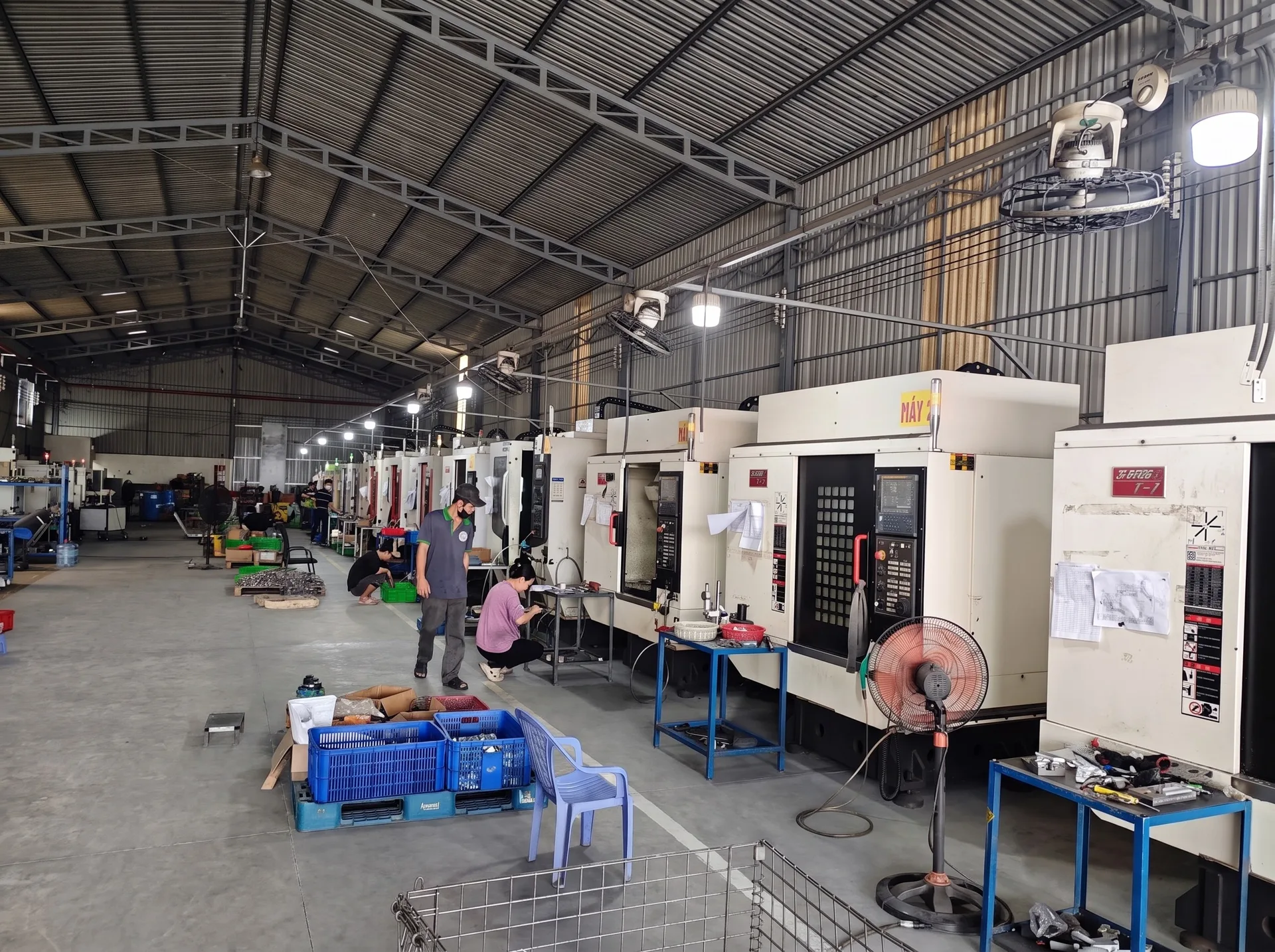
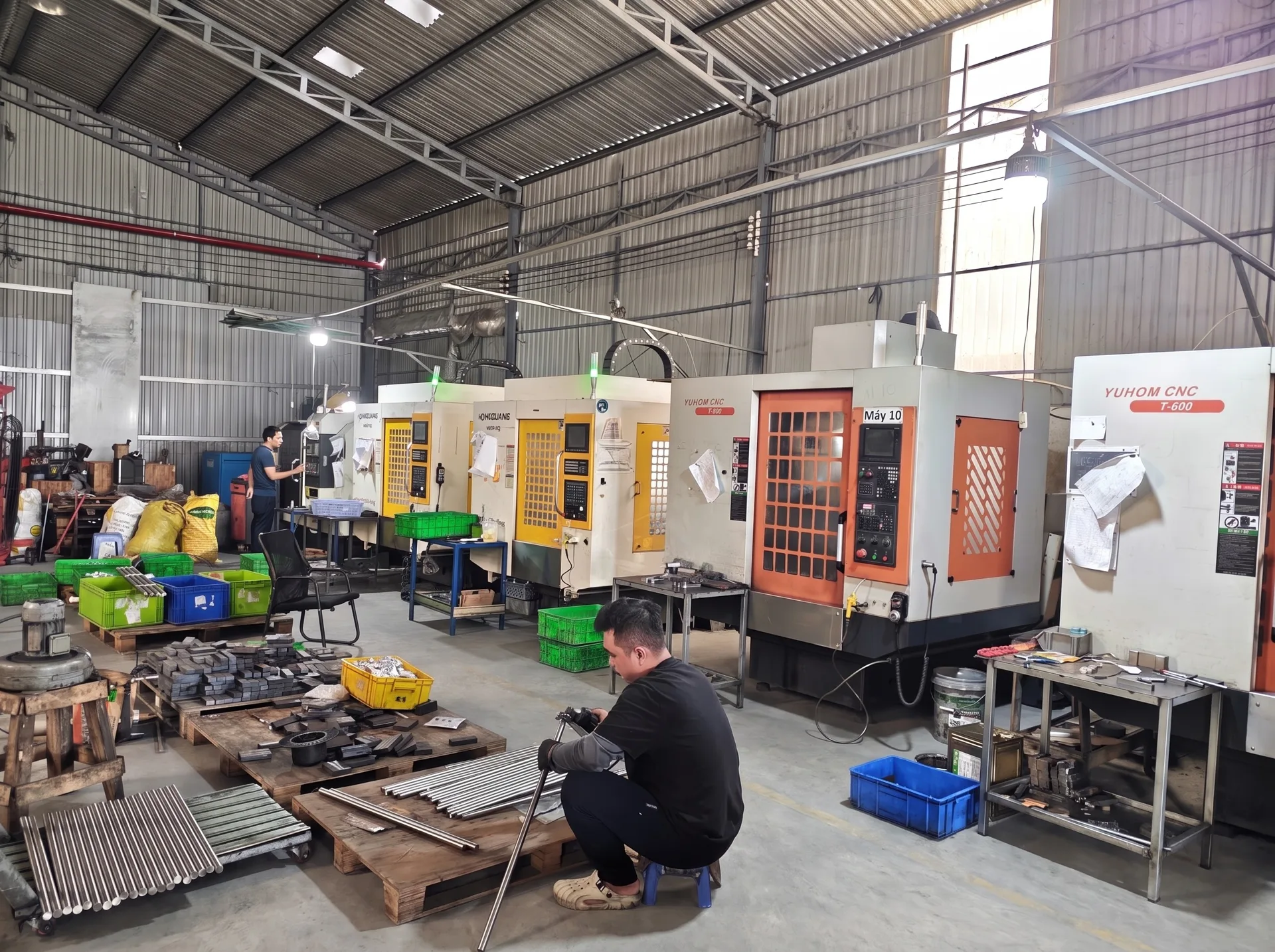
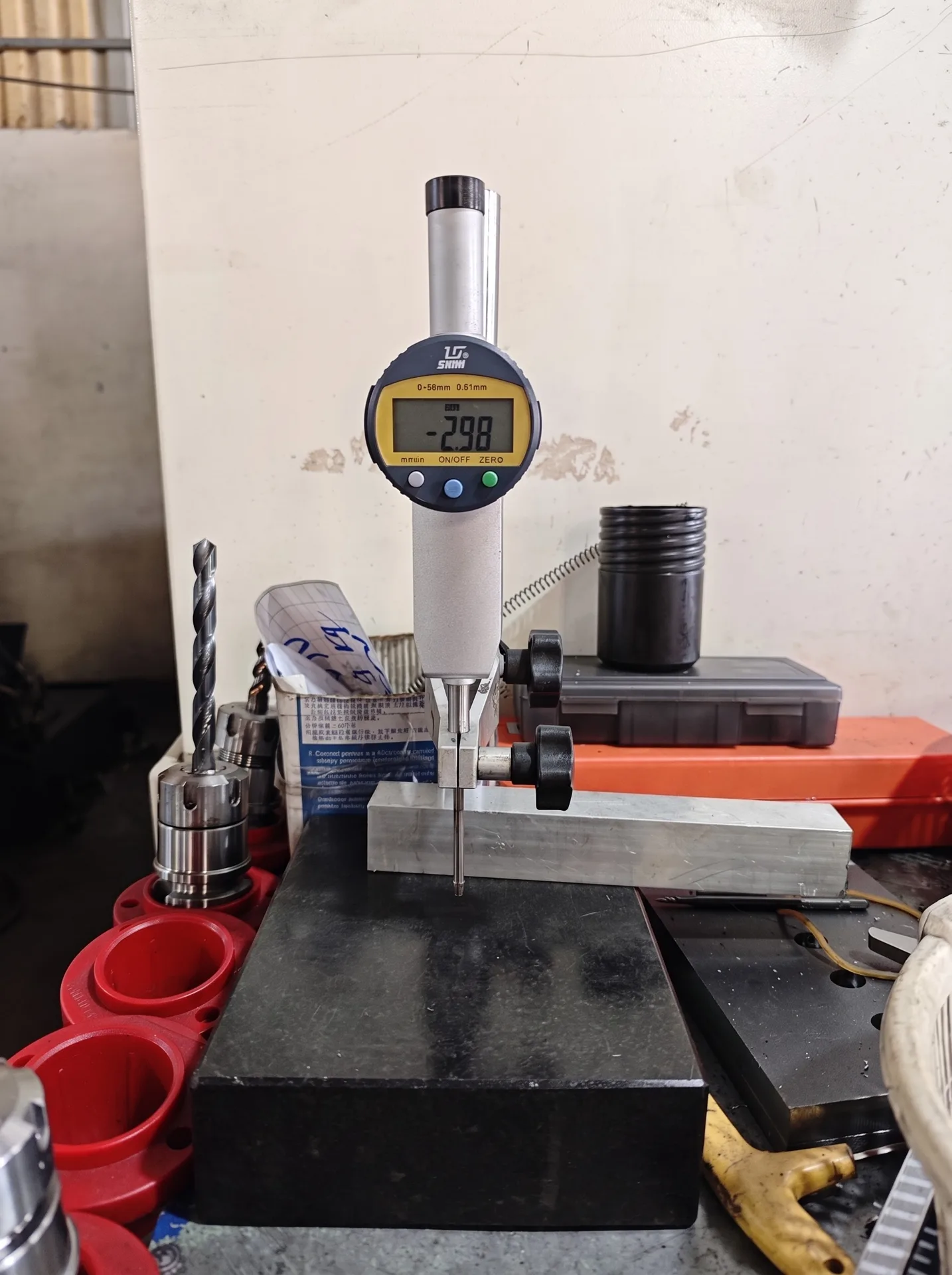
Finally, the floor itself. The factory page offers a live video walk of the machines, the inspection bench and the packing line, or a visit with pickup at Tan Son Nhat International Airport (SGN), which the page puts at about 45 minutes away by car.
The photographs below are of the plant's own floor, digitally cleaned up (AI-assisted) for lighting.
What does Saola put in writing that a buyer can check?
Nine things, each published on a page of this site that you can hold Saola to. None of them is a certification; each is a disclosure.
- The legal entities are named, the company that signs the quote and the lead CNC plant, and their business registration certificates are sent on request (quality).
- Every process is labeled as run at the lead CNC plant or managed through a partner plant (factory).
- Each managed card states that the work itself happens at a partner's plant.
- A material traceability file is kept per part number: invoices, supplier and country of origin for the metal (tariffs and origin).
- A written English routing shows the operations and the value added in Vietnam.
- A CBP binding-ruling filing is prepared on request, with the plain statement that the outcome is CBP's decision, not the plant's.
- The owner is reachable directly, with no layer of account managers in between.
- The lead CNC plant's floor can be walked on a live video call or in person.
- The gaps are published too: no ISO 9001 certificate yet (certification in progress), no third-party quality audit, and no compiled PPM or on-time-delivery record.
The last item is the one most sellers leave out. It is on the quality page because a buyer will find it during qualification anyway, and it is cheaper for both sides to learn it before a drawing is sent. One more line from the tariffs page belongs here: importer-of-record responsibility does not transfer to the supplier by way of a quote or a Certificate of Origin. The file supports your case; it does not take your liability.
CNC turning and CNC milling run at our lead CNC plant; die casting, stamping and surface finishing go through partner plants we manage.
Where is Saola itself the middleman?
For every managed process, Saola does what a trading company does: it places the work with a partner plant and holds the drawing, the purchase order and the incoming inspection. The difference is that it says so on every quote.
The managed processes are die casting, stamping, sand casting and all surface finishing, plus aluminum extrusion, injection molding, sheet metal and laser cutting, waterjet cutting and rotational molding. For each of them the work happens at a partner's plant, not at the lead CNC plant, and the quote names the production site and origin. Castings are a partial case. A partner foundry pours the body. The machining and thread gauging of that casting then run at our lead CNC plant, and any finish is applied by a partner plant.
So the honest comparison is not "manufacturer good, intermediary bad". What serves a buyer is a seller that labels which operations run at its lead plant and which it places, because that label is the fact an origin file or an audit needs. If your part depends on a managed process, ask for the partner-plant details in the quote.
How do the two routes compare, row by row?
The table compares buying through a trading company with buying from Saola Manufacturing on dimensions that can be traced to a regulation or a published page. Where no public data exists, the cell says so instead of guessing.
| Dimension | Buying through a trading company | Buying from Saola Manufacturing | Basis |
|---|---|---|---|
| Who makes the part | A factory the seller does not own; identity may or may not be disclosed | T.K Viet Nam Precision Company Limited for CNC turning and milling; casting, stamping, finishing and other processes at managed partner plants, labeled on the quote | Factory page |
| Plant visit or live video walk | Depends on the intermediary; not published | Offered, including airport pickup | Factory page |
| Material source documents | Depends on what the factory passes on; not published | Invoices, supplier and country of origin per part number | Tariffs and origin page |
| Origin test | Substantial transformation where made; the invoicing party does not change it | Same test; routing and value added documented | 19 CFR 134.1(b) |
| Importer-of-record duty | Stays with the importer | Stays with the importer | 19 USC 1484(a); tariffs FAQ |
| Engineering contact | Through the intermediary | Owner and plant directly | Factory page |
| Several processes on one order | Possible across several factories | Lead-plant machining plus labeled managed partners | Home page |
| ISO 9001 | Depends on the factory | Not held; certification in progress | Quality page |
| Price and margin | Not published | Set per part in the written quote; no public prices | FAQ page |
Two rows apply the same rule to both routes on purpose. The origin test and the importer's duty do not care which route you choose, and any seller who implies otherwise is overselling. What differs is how directly you can reach the facts those rules ask for.
When is a trading company still the right choice?
When you need many unrelated part families from many plants on one contract, or processes no single plant runs, an intermediary that coordinates them can be worth it. Ask it to name each factory and pass on each routing.
Every supplier has a scope. Saola runs CNC turning and milling at its lead plant and manages casting, stamping, finishing and the other partner processes, and the FAQ lists the work it turns down, including simultaneous five-axis machining and programs too small for tooling to pay off. If your basket sits mostly outside that scope, a good trading company may serve you better than several direct relationships you have to manage yourself.
If you stay with an intermediary, write the documentation into the purchase agreement: factory name and address, material certificates, the routing, and access for an audit or a video walk. The RFQ preparation guide lists what else to put in the package.
Frequently asked
Is a trading company the same as a sourcing agent?
Not always. A trading company usually buys and resells; a sourcing agent often works for you while you contract with the factory. The test is the same for both: will they name the plant and pass on its documents?
If my supplier invoices from one country and the plant is in another, which is the origin?
For US marking and duty purposes, origin follows manufacture and substantial transformation under 19 CFR 134.1(b), not the invoicing company. Confirm your specific case with your customs broker.
Does buying direct from a plant move customs liability to the plant?
No. The importer of record keeps the duty of reasonable care under US law. A plant can give you better evidence, such as a routing and a material file, but the declaration is still yours.
Does Saola make every part in its own plant?
No. CNC turning and milling run at our lead CNC plant, T.K Viet Nam Precision Company Limited. Die casting, stamping, surface finishing and other processes are managed through partner plants and labeled that way, and the quote names the production site and origin, so you know which is which before you order.
What should I send to start?
A drawing, the material and finish, your expected volume, and a note on what your origin file or audit needs. Start a quote and ask for the routing and material file with it.
Sources
- 19 CFR 134.1, Definitions (country of origin), Electronic Code of Federal Regulations, accessed September 2026
- 19 CFR 177.1, General ruling practice and definitions, Electronic Code of Federal Regulations, accessed September 2026
- 19 CFR 177.2, Submission of ruling requests, Electronic Code of Federal Regulations, accessed September 2026
- 19 USC 1484, Entry of merchandise, United States Code via Legal Information Institute, accessed September 2026
- Implementation of Decision 1103/QD-BCT on certificates of origin, Ministry of Industry and Trade of Vietnam, April 23, 2025