
Guide
Is electropolishing aluminum better than bright dipping or mechanical polishing?
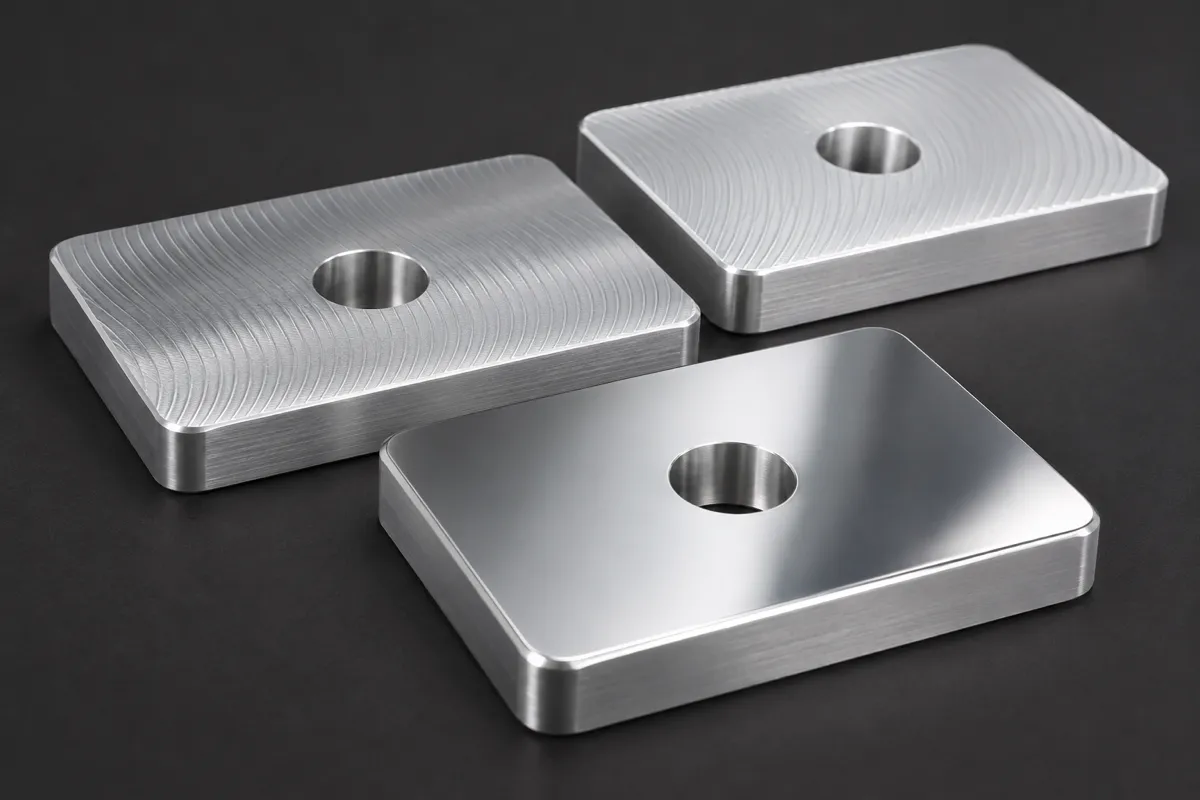
Electropolishing aluminum is an anodic process that dissolves a thin layer of metal in an acid electrolyte, usually phosphoric-acid based, to brighten and smooth the surface; bright dipping does a similar job chemically without current, and mechanical polishing cuts the surface smooth with abrasives. On machined aluminum, only mechanical polishing reliably removes tool marks; electropolishing and bright dipping mainly add brightness, and on a milled 7075 surface electropolishing can even make roughness worse.
By Saola Manufacturing engineering team · Published · Updated
This guide is for engineers and buyers who want a bright or reflective aluminum part and are choosing a process name for the drawing. It draws on MIL-A-8625F (1993) for how brightening relates to anodizing, two Alcoa patents for bright dip practice, a 2020 laboratory study by Abdel-Fattah and Loftis on electropolishing aluminum, and a 2023 Universidad Nacional de Colombia thesis on electropolishing milled 7075. Electropolishing of stainless steel is a different process with its own standard, covered in our electropolishing vs passivation guide.
On this page
How does electropolishing aluminum differ from bright dipping and mechanical polishing?
Electropolishing removes metal electrochemically under current, bright dipping removes it chemically in a hot acid bath without current, and mechanical polishing removes it with abrasives; the first two brighten, the third levels.
Both chemical routes are named together in MIL-A-8625F: when a highly reflective surface is specified, parts are chemically or electrochemically brightened before anodizing, and the reflectivity obtained depends on the alloy and on the anodic coating thickness. The Alcoa US patent 4,483,750 describes the chemical route in practice as a hot mixture of phosphoric and nitric acids, and notes that the metal is first bright rolled or mechanically finished to a smooth surface.
That order matters. Brightening polishes on a microscopic scale; it does not turn a milled face into a mirror. Per US patent 5,290,424, the finished part cannot be more reflective than the surface after pretreatment, so the smoothness has to exist before the brightening step.
| Point | Electropolishing | Bright dip (chemical brightening) | Mechanical polishing or buffing |
|---|---|---|---|
| How metal is removed | Anodic dissolution in an acid electrolyte, with current | Hot phosphoric-nitric acid bath, no current | Abrasive cutting and smearing |
| Effect on tool marks | Rounds peaks; does not reliably level milling marks | Brightens; needs an already smooth surface | Removes them if enough stock is taken |
| Effect on Ra | Reduced on pure aluminum in the lab; worse on milled 7075 in most trials | Little leveling; brightness depends on alloy purity | Lowest Ra when done well |
| Edges and corners | Reaches complex shapes; removal typically varies with current distribution | Uniform on complex shapes | Rounds edges; hard in recesses |
| Alloy sensitivity | High; alloying elements and inclusions etch differently | High; iron and silicon lower reflectivity | Low |
| Usual next step | Thin anodize or clear coat | Thin anodize | Anodize, clear coat or left bare |
How much does electropolishing remove, and what does it do to Ra?
Removal is small but real, typically a few micrometers, and the Ra change depends heavily on the starting surface and the electrolyte; one laboratory study on pure aluminum cut Ra by almost 40 percent in phosphoric acid while removing about 8 µm.
In the study by Abdel-Fattah and Loftis, the phosphoric acid electrolyte that the authors call the industry standard reduced roughness less than an experimental solvent, and they attribute some pitting to hydrogen bubbles. Those are lab results on 99.98 percent aluminum sheet, not on a machined alloy part, so treat them as an indication of scale, not as a process capability.
For a dimensioned part, a few micrometers off every surface still matters on bores and fits, and the removal is typically greater at edges and corners than on flat faces. Masking or a finish allowance should be agreed for tight features.
| Electrolyte | Ra before (nm) | Ra after (nm) | Step height removed (µm) |
|---|---|---|---|
| 1 M phosphoric acid, the industrial standard named in the study | 159.1 | 97.7 | 8.1 |
| Choline chloride and ethylene glycol deep eutectic solvent | 159.3 | 26.6 | 7.2 |
Will electropolishing smooth a machined aluminum part?
Not reliably: in a 2023 study on milled 7075-T651, electropolishing made the measured roughness worse in seven of nine time and voltage combinations tested.
The Universidad Nacional de Colombia thesis milled 7075-T651 specimens under controlled conditions and then electropolished them in a phosphoric-acid electrolyte. Only two of the nine parameter sets were exceptions to that result. The author’s conclusion is the useful one for buyers: electropolishing is not meant to remove significant material, and its result depends strongly on electrolyte, agitation and cell design.
High-strength alloys are the hardest case, because their alloying elements and second-phase particles dissolve at different rates from the aluminum around them. If the goal is a smooth machined surface, specify the Ra you need and let the supplier reach it by machining and mechanical polishing first.
Which aluminum alloys brighten well?
High-purity alloys made for bright finishing brighten best; US patent 5,290,424 names 5252, 5552 and 5657 among the 5XXX alloys and 6306 among the 6XXX alloys as most preferred for reflective trim.
For electropolishing the alloy question is sharper than for bright dipping, because the current concentrates attack on whatever dissolves fastest. MIL-A-8625F says only that certain alloys are more capable of a highly brightened surface; in practice that means asking the finisher for a sample on your actual alloy and temper before the drawing is released.
Common machining alloys such as 6061 and 7075 are not bright-finishing alloys. They can be brightened, but expect a hazier, less even result, and do not specify a reflectance number on them without a qualified sample. The clear anodize guide shows how alloy changes appearance after anodizing.
Does anodizing after brightening keep the shine?
Partly: anodizing protects the brightened surface, but per MIL-A-8625F thicker anodic coatings reduce reflectivity, so bright parts normally get a thin coating.
Reflective trim products, such as the one in US patent 5,290,424, keep the oxide far thinner than a typical protective Type II coating, so a part that must be both very bright and very durable is a compromise, and the drawing should say which wins. An etch step before anodizing would also undo the brightening, so the anodize note should say that no etch is allowed after electropolishing.
For decorative parts, the usual answer is a thin clear anodize over a brightened surface, with the coating thickness and the appearance sample both written on the drawing.
How should a bright finish be specified on the drawing and RFQ?
Specify the result and the sequence, not just a process name: the Ra before finishing, the brightening process, the anodize type and thickness, the significant surfaces, and an approved appearance sample.
A typical workable note reads “MACHINE AND POLISH SIGNIFICANT SURFACES TO Ra ___ MAX, THEN ELECTROPOLISH, THEN ANODIZE PER MIL-A-8625 TYPE II CLASS 1, THIN COAT; APPEARANCE TO APPROVED SAMPLE”, with the blank filled by the roughness your own design needs; our surface finish symbol guide shows how to write that value. Mark the significant surfaces on the drawing, because recesses and blind holes will not brighten like flat faces.
Agree removal on fits. If a bore or a thread must stay in tolerance, mask it or give a finish allowance, and say which.
Can Saola supply electropolished or bright dipped aluminum parts?
Electropolishing and bright dipping are not on the current finish menu, so a drawing that calls for either must be raised at drawing review; anodizing on aluminum is on the menu as a managed process at partner plants.
Finishes are supplied from a fixed menu of eight, run by partner plants and listed on the surface finishing page. Grinding and polishing are among the lead plant’s own operations alongside CNC milling and turning, and whether a required Ra and appearance can be met is confirmed at the same review.
Send the drawing with the finish note exactly as written and any appearance sample or reference photo, so the review can answer the brightening question before a price is given.
Frequently asked
Is electropolishing aluminum the same as anodizing?
No. Electropolishing removes metal to brighten the surface; anodizing grows an oxide layer from it. Bright parts are often electropolished or bright dipped first and anodized after.
Does electropolishing improve corrosion resistance of aluminum?
It leaves a cleaner surface, but the protection on a bright aluminum part normally comes from the anodic coating or clear coat applied afterward, not from the polishing step itself.
Is ASTM B912 used for aluminum electropolishing?
No. ASTM B912 covers passivation of stainless steel by electropolishing. Aluminum brightening is normally specified by the result, the process sequence and an appearance sample.
Can cast aluminum be electropolished?
Expect a less even result on high-silicon casting alloys, because silicon particles typically do not dissolve like the aluminum around them. Treat any casting alloy as a sample-first job.
Why do bright aluminum parts vary between lots?
Alloy purity, the condition of the bath and the anodic coating thickness all change reflectivity, per MIL-A-8625F and the Alcoa patents. Control them with an approved sample and a stated sequence.
Sources
- MIL-A-8625F, Anodic Coatings for Aluminum and Aluminum Alloys, paragraphs 3.3.3 and 6.9, US Department of Defense, 10 September 1993
- Abdel-Fattah, T. M. and Loftis, J. D., Comparison of Electropolishing of Aluminum in a Deep Eutectic Medium and Acidic Electrolyte, Molecules 25(23):5712, 2020
- Echavarría Ramos, J. S., Exploración del proceso de electropulido como acabado final aplicado a superficies maquinadas en moldes, master’s thesis, Universidad Nacional de Colombia, 2023
- US 5,290,424, Method of making a shaped reflective aluminum strip, doubly-protected with oxide and fluoropolymer coatings, Aluminum Company of America, 1994
- US 4,483,750, Process for anodizing highly reflective aluminum materials, Aluminum Company of America, 1984