Bushings & bearing sleeves
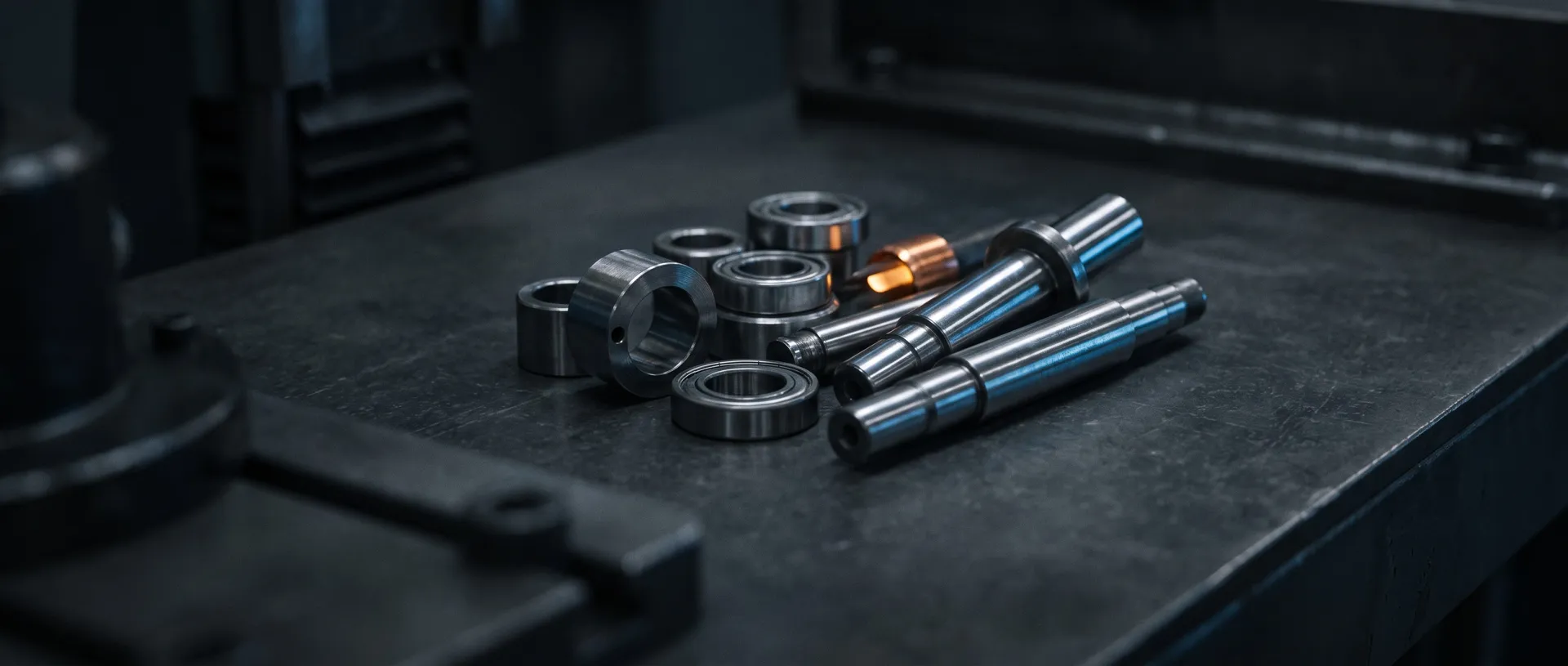
Turned from silicon bronze or 52100 steel bar, held to a running fit against a shaft or pin, polished on the bore.
Machine tool & industrial equipment · Vietnam-made
Bushings, eccentric rings, spacers, shafts and silicon-bronze wear parts for spindles, fixtures and drive assemblies. The material callout, the bore concentricity and the surface finish are called out tightly, and we hold them. A loose fit shows up as vibration, not a rejected part.
01 — The parts we make for this industry
These parts sit inside the machine, not on the outside. Nobody is grading them on looks — they are graded on whether the assembly runs true.
Turned from silicon bronze or 52100 steel bar, held to a running fit against a shaft or pin, polished on the bore.
Turned and milled in 12L14 or C1117 steel, offset bores held on center, keyways cut to print for a positive drive.
Die cast in ADC12 aluminum, machined for the bearing bore and mounting face, anodized for wear resistance on handled surfaces.
Turned from 52100 steel or aluminum 2011-T3, keyed or knurled where the drawing calls for a press or set-screw fit.
Stamped or milled from aluminum 6061-T6, anodized or powder coated depending on the exposure inside the machine enclosure.
Sand cast and machined in-house for slide ways, worm gears and other low-friction contact surfaces that see continuous cycling.
02 — What actually matters on these parts
None of these show up on a visual inspection. They show up as noise, heat or premature wear three months after the machine ships.
Machined bores on castings hold ±0.025 mm with GD&T concentricity to Ø0.003 in. A bore off axis by even a little loads a bearing unevenly and shortens its life.
Running and mating surfaces are held to 125 RMS. A rougher finish on a bushing bore or a sliding face wears the mating part faster than it should.
A print calling for 52100, C1117, 12L14, 2011-T3, 6061-T6 or silicon bronze chose that alloy for a reason. It comes down to hardness, machinability or wear resistance, and we run the material on the drawing, not a lookalike.
Where the drawing calls for heat treatment, it runs as part of the routing before final machining and finish, not as an optional extra.
03 — Typical routing by part family
Process route, material and finish for the part families above. Confirmed against your drawing before quoting.
| Part family | Process route | Material | Finish |
|---|---|---|---|
| Bushings & bearing sleeves | CNC turning | Silicon bronze / steel 52100 | Polish, oil-dip rust protection |
| Eccentric rings & spacers | CNC turning + milling | 12L14 steel / C1117 steel | Zinc plating, heat treatment |
| Spindle housings | Die casting + CNC milling | ADC12 aluminum | Anodizing |
| Drive shafts & collars | CNC turning | Steel 52100 / aluminum 2011-T3 | RoHS blue trivalent chromate |
| Structural brackets | Stamping / CNC milling | Aluminum 6061-T6 | Anodizing, powder coating |
04 — One part, one supplier
A representative routing for this industry. Every step happens inside our own plant, so the tolerance chain is set once and held through finish.
Silicon bronze or steel bar turned to the outer profile and the offset bore center.
Keyway and secondary features cut to print, bore concentricity checked in the same setup.
Run where the drawing calls for it, before final grinding and finish.
Running surfaces held to 125 RMS, then plated or oil-dip treated for the service environment.
Dimensional and GD&T check against print, individual bagging, cartons under 30 lb.
05 — Where we are the wrong shop
Complex contoured features cut in one setup on a five-axis machine are outside what we run. If your part needs that, we will tell you on the first call, before the tooling deposit.
That is our routine turned-feature tolerance, not our floor. If a fit needs tighter, put it on the drawing and we will tell you plainly whether we can hold it.
We run 52100, C1117, 12L14, 2011-T3, 6061-T6, silicon bronze and a small set of others. A print calling for something outside that list needs a separate sourcing conversation before we quote. Tell us early, not after the drawing is finalized.
06 — Before you send a drawing
Short answers here; the rest on the FAQ page.
Yes. Bores machined into castings in-house hold ±0.025 mm with GD&T concentricity to Ø0.003 in, checked at final inspection against your callouts.
Yes — sand cast in-house and machined on the same site, which is how most of our bushing and wear-part programs run.
Then we are the wrong shop for that feature, and we will say so directly rather than quote something we cannot hold. Ask us for a referral if that is the only blocker.
STEP or PDF, one part or a whole family. You get a unit price at your volume, the tooling cost and the lead time. We also flag any fit or material callout worth a second look. Turnaround is two business days.